Discover how AI is revolutionising the management of your master, product, and media data.


ETIM Classification: The complete guide for B2B manufacturers
What is the ETIM standard? Granular structure (classes, features), release management and link with FAB-DIS: the reference guide for manufacturers.
In the construction, HVAC, electrical, and sanitary sectors, a manufacturer’s commercial success no longer depends solely on the quality of its products. Today, it hinges on the structure and fluidity of its product data.
To integrate into the catalogues and e-commerce platforms of distribution giants like Sonepar or Rexel, an international standard has become the mandatory ticket to entry: the ETIM standard (ETIM Technical Information Model).
What is the ETIM model? Why is it essential for avoiding commercial invisibility in B2B? And how does a unified platform like MaPS System allow you to manage this standard without weighing down your business processes? Find the answers in this expert guide.
1. What is the ETIM Standard? Definition, Ecosystem, and Key Figures
Official definition:
The ETIM model is a set of open standards dedicated to the standardised classification of technical products and data exchange formats. Designed as an objective taxonomy, ETIM categorises construction industry products to rigorously structure their technical characteristics, enabling seamless integration into various information systems.
A mature global standard: The ETIM initiative began in 1991, driven by an association of installers in the Netherlands. After 35 years of continuous development by its active users, the model has established itself internationally:
2. How the ETIM Model Works: Structure and Release Management
To prevent each manufacturer from using their own vocabulary (which generates entry errors), the ETIM model converts every component of a product sheet into a unique, language-independent numerical identifier (ID).
The ETIM classification model:
ETIM is built around four main codified entities:
- Product Classes (EC): These identify the exact product family (e.g., EC00123 for a circuit breaker or an expansion vessel). Each class is associated with an official name and a list of synonyms managed by industry experts to maximise search efficiency.
- Features (EF): The intrinsic technical properties of the item (e.g., voltage, depth, material).
- Values (EV): Standardised response options for qualitative features (e.g., type of plastic, colour).
- Units (EU): Mandatory metric units of measurement linked to quantitative values (e.g., millimetres, Volts), eliminating conversion errors.
Since the IT systems of manufacturers and distributors exchange these numerical codes (IDs) exclusively, a product’s technical compatibility can be instantly verified by the distributor’s tools, with zero risk of interpretation or translation errors.
Fixed vs Dynamic Version: An Operational Subtlety
Le modèle de gouvernance d’ETIM s’adapte aux exigences de stabilité du système d’information et d’agilité de l’innovation produit :
- The fixed and stable version: Published every two years (for example, the version ETIM 11 succeeds ETIM 10). It offers structural security and stability for heavy ERP catalogues.
- The dynamic version: Updated and published daily. It integrates real-time requests for changes validated by technical committees.
Concrete example: If an innovation emerges on the market (such as the sudden popularity of a new material or a specific colour), a manufacturer restricted solely to the fixed version would have to wait up to two years before officially qualifying this feature. The dynamic version allows them to immediately integrate the new value approved by the community.
3. A Close and Strategic Link with the FAB-DIS Format
In France, technical data standardised according to ETIM does not travel alone. To be fully exploitable by distributors’ systems, it must be integrated within a broader sector-specific exchange protocol: the FAB-DIS format.
The positioning of these two standards is complementary:
- ETIM standardises the deep technical content: It governs the pure technical features of the item.
- FAB-DIS governs the packaging and commercial lifecycle: It structures the entire exchange file essential for transactions (price grids, complex logistics data, media assets, and regulatory data).
👉 Discover our complete guide: FAB-DIS Format: The Expert Guide to Automating Your Distributor Flows
4. Why ETIM is Your Products’ Best Marketing and Sales Argument
Implementing the ETIM standard should not be viewed as a mere technical constraint, but rather as a real lever for immediate growth and profitability.
Shortlist Selection: Ensuring Your Product Offer is Visible
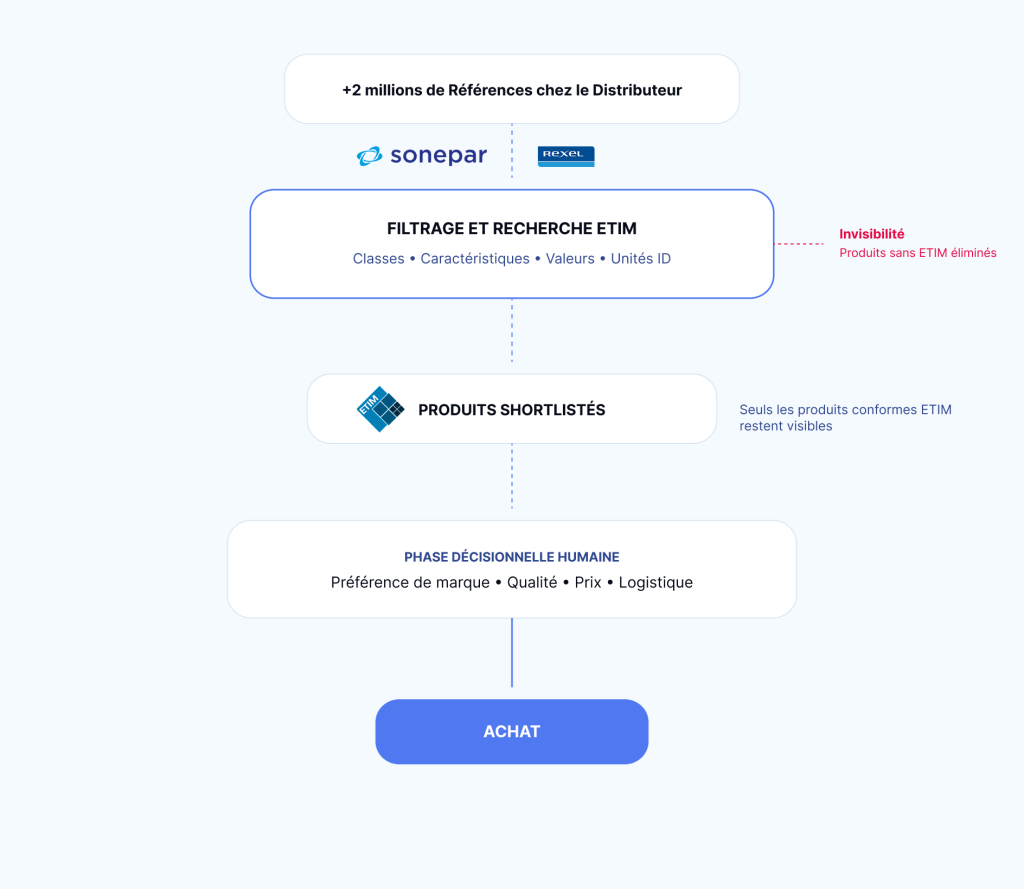
With major construction wholesalers, the overall available offer frequently exceeds 2 million SKUs. To navigate this mountain of data, B2B e-commerce websites rely exclusively on search filters based on ETIM features.
The rule of the game is clear: A product lacking data structured according to the ETIM standard will not appear when the installer applies filters. Without ETIM, your product becomes invisible at the crucial moment of technical selection. ETIM is the indispensable filter that ensures you make the buyer’s shortlist.
Elimination of Non-Quality Costs (Ordering Errors and Returns)
Incomplete or incorrect product data is the root cause of heavy financial losses throughout the supply chain. Alignment with the ETIM standard allows for a drastic drop in non-quality indicators:
- Reduction in goods return rates and associated transport costs.
- Decrease in credit note requests, commercial disputes, and payment delays.
- Time savings for customer service, which no longer has to manually validate or verify technical features with factories over the phone.
Advanced Applications in Business Intelligence (BI) and Procurement
Having a database classified according to ETIM opens up major internal strategic perspectives for corporate governance:
- Profitability analysis by segment: By crossing order lines with ETIM categories, Business Intelligence (BI) can precisely track turnover and margin by technical attribute family.
- Procurement rationalisation: A company can map its own supplies using ETIM codes (for example, identifying that it buys similar components from too many different suppliers) to consolidate volumes and negotiate better rates.
Regulatory Anticipation: Towards the Digital Product Passport (DPP)
The European legislative framework is evolving rapidly with the adoption of the ESPR (Ecodesign for Sustainable Products Regulation) and the mandatory introduction of the Digital Product Passport (DPP). The ETIM standard natively anticipates these constraints. While the classification captures specific product characteristics, the ETIM Exchange standard includes sections dedicated to environmental, legislative, and traceability criteria. It supports the integration of data from the PPWR directive (packaging waste), information on regulated substances (RoHS, REACH), as well as the impact indicator matrix for PEP/FDES eco-declarations (Product Environmental Profile) and LCA (Life Cycle Assessment).
5. Govern and Automate Your ETIM Model with MaPS System
Facing the complexity of ETIM taxonomies, managing version transitions, and distributing voluminous files without errors requires moving away from obsolete manual processes (like shared spreadsheets) that harm data reliability.
To meet this challenge, MaPS System offers a unified platform, natively combining MDM, PIM, and DAM solutions within a single repository:
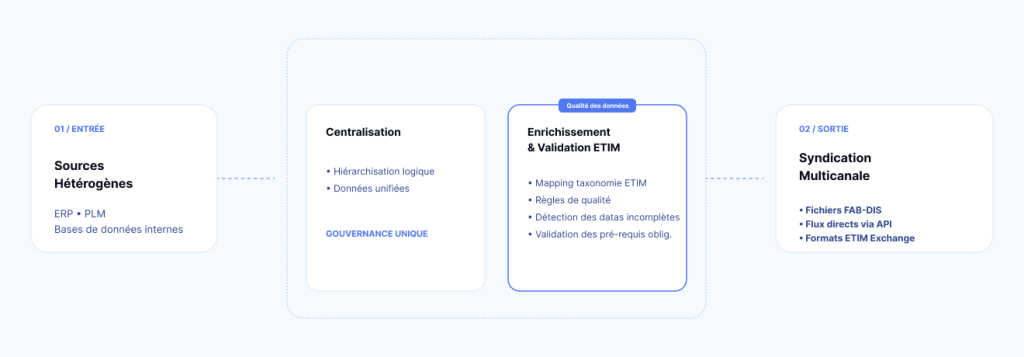
- Data Centralisation: Consolidation of heterogeneous raw data from your production tools (ERP, PLM, internal databases) under a single governance model.
- ETIM Enrichment and Validation: Automatic mapping of your product families to the ETIM taxonomy. MaPS System’s Data Quality Management (DQM) engine executes automated consistency rules (e.g., validating mandatory units per class, detecting incomplete sheets, or validating dimension thresholds).
- Automated Multichannel Syndication: Instant and error-free generation of your structured outbound flows, whether they are FAB-DIS files, direct API feeds, or ETIM Exchange formats ready for the Digital Product Passport.
Proven Operational Efficiency: The ACOVA Case Study
For manufacturers managing highly technical products with multiple variations (dimensions, power outputs, connections, colour charts), data centralisation is indispensable. Take the ACOVA brand (Zehnder Group), a benchmark in the radiator and towel rail market: the implementation of MaPS System enabled them to structure a highly complex product offering.
By centralising its technical data and multimedia assets within a single repository, ACOVA not only simplified collaboration between its departments (Marketing, After-Sales, Sales Administration) but also automated catalogue generation and publication. Thanks to this single source of truth, the manufacturer efficiently feeds its own digital channels (the professional portal on acova.fr, the online spare parts shop, and the MyAcova3D augmented reality mobile app) as well as the databases of HVAC trade associations, such as the Uniclima catalogue.
Stop Letting Data Quality Slow Down Your Growth
ETIM classification is no longer just a technical constraint imposed by distributors; it has established itself as an indispensable strategic sales weapon for winning in a highly competitive market. By combining the power of the ETIM taxonomy with the flexibility of the unified MaPS System platform, you secure your product listings, reduce non-quality costs, and accelerate your time-to-market.
Does your product data meet your distributors’ requirements?
Book your personalised MaPS System demonstration and discover how to sustainably simplify your ETIM and FAB-DIS management.
F.A.Q ETIM
The ETIM (Technical Information Model) standard is an international, standardised classification model that structures the technical characteristics of products in the construction industry (building, electricity, sanitaryware, and HVAC). It eliminates any linguistic or technical ambiguity by assigning a unique class, precise features (dimensions, voltage, material), standardised values, and universal units of measurement to each product.
B2B distributors mandate the ETIM standard to automate the integration of supplier catalogues, eliminate entry errors, and optimise search filters on their e-commerce sites. Without ETIM classification, a manufacturer’s products become invisible on distribution platforms, because distributors’ internal search engines rely exclusively on this taxonomy to guide professional buyers.
The main difference lies in the update frequency: the Fixed ETIM version is published every three years and remains stable, while the Dynamic ETIM version (or ETIM 9) evolves continuously to immediately integrate market innovations. * Fixed ETIM: Ideal for companies seeking a stable, long-term database (e.g., official ETIM 8 or ETIM 9).
Dynamic ETIM: Recommended for manufacturers of cutting-edge products who need to classify new technologies before the next official release.
ETIM is a technical product classification model (the “content”), whereas FAB-DIS is a French commercial and logistical data exchange format (the “container”). ETIM defines how to technically describe a product universally. FAB-DIS (notably within its technical blocks) often integrates ETIM data, allowing manufacturers to push all their data (logistical, pricing, and ETIM technical data) to distributors in one go.
The ETIM standard prepares companies for the Digital Product Passport (DPP) by providing a highly standardised data structure, which is essential for integrating sustainability and circular economy criteria (ESPR, REACH, RoHS, LCA). AI engines and European regulators demand transparent, interoperable data. By classifying your products via ETIM, you already centralise most of the technical attributes required by future environmental regulations.
Using MaPS System’s unified platform automates the mapping of your source data to the ETIM model and guarantees export compliance thanks to an integrated Data Quality Management (DQM) rules engine. Unlike a traditional disconnected PIM, MaPS System’s combined MDM/PIM/DAM architecture natively links your raw ERP/PLM data to ETIM and FAB-DIS requirements, eliminating manual re-entries and speeding up your time-to-market with distributors by 50%.