Discover how AI is revolutionising the management of your master, product, and media data.


Digital Product Passport (DPP): Anticipate upcoming obligations with the MaPS System PIM
On April 30th, we had the pleasure of participating in the GS1 Partner Day, where European regulation was at the heart of the discussions. In sight: the progressive entry into force of the DPP (Digital Product Passport), an ambitious project born from the ESPR (Ecodesign for Sustainable Products Regulation). The objective of this “product passport” is to trace the environmental footprint of goods marketed in Europe, whether they are manufactured locally or imported.
The DPP: a structuring challenge for companies facing European regulation
The European objective is ambitious: to achieve carbon neutrality by 2050. The DPP is part of this dynamic by imposing the collection, validation, and sharing of precise data on:
- ecodesign,
- product durability and repairability,
- material origin,
- recycling or reuse conditions.
Behind this European ambition is an operational reality: companies will have to provide an enriched, interoperable product sheet, structured according to standards still under construction, and accessible via a unique identifier (such as QR code, RFID, etc.).
This implies significant changes in how products are developed, manufactured, and marketed, as well as a profound transformation of companies’ internal processes. For example, the integration of eco-design criteria is a potential growth lever (up to +20% turnover according to McKinsey*). Production teams will have to adapt their systems for the collection and sharing of traceability data required by the European DPP.
DPP: which sectors will be impacted starting in 2027?
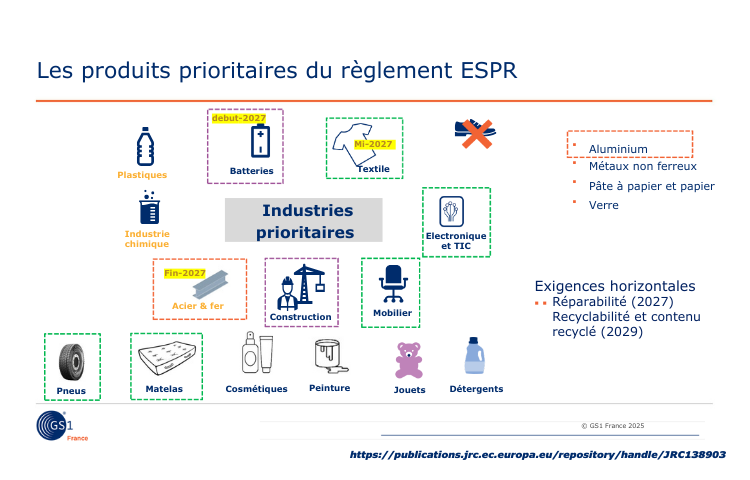
From 2027, several sectors will be obliged to provide a digital product passport:
- Textile (excluding footwear),
- Electronics,
- Furniture,
- Tires,
- Mattresses.
Other so-called “intermediate” products such as batteries or steel are also targeted.
As early as 2023, with the adoption of Regulation (EU) 2023/1542**, the European Union confirmed the implementation of a digital passport for industrial, electric vehicle, and light mobility batteries.
This passport, mandatory from February 2027, must gather key information: composition, traceability, carbon footprint, manufacturing conditions, all accessible via a unique QR code affixed to each battery.
This first wave will serve as a laboratory and set the tone for progressive generalisation to all physical goods marketed (manufactured or imported) in Europe.
The DPP standards: a clear direction for product compliance in Europe
While the technical specifications of the DPP are still being defined (GS1 is currently working on the adoption of its standard by Europe), one thing is certain: data will be at the heart of the system.
Identification, enrichment, traceability, and the capacity to produce compliant exports—all these aspects require a robust platform to:
- aggregate data,
- ensure its quality,
- distribute it to the right channels,
- update it according to product or regulatory changes.
MaPS System: prepare for regulation now
We are already supporting our clients on structuring projects around product data. Compliance, standardisation, quality improvement, export according to expected formats (FAB-DIS, GDSN, etc.). The DPP is part of this continuity.
Our platform, by combining MDM, PIM, and DAM, offers a solid foundation to:
- prepare the data expected for the DPP,
- integrate sectoral evolutions (textile, cosmetics, etc.),
- ensure regulatory traceability,
- manage multichannel needs with personalised exports.
The DPP is a structural transformation of product data. Furthermore, MaPS System is already a natural facilitator of this compliance.
A concept already experimented before European regulation
We want to remind you that the concept of a digital product passport does not come out of nowhere.
Well before European regulation sought to impose a common framework, certain companies had already engaged in voluntary initiatives to meet the expectations of transparency, traceability, or circularity expressed by their customers.
For example, the LVMH group launched an experiment with the startup Arianee as early as 2021 to equip its luxury products with a secure digital passport. Objective: to track the origin, authenticity, and lifecycle of the product.
This type of initiative shows that brands and manufacturers have not waited for institutions to initiate virtuous approaches, even if the formats or standards used until now did not yet correspond to the expectations of the DPP at the European level.
Augmented QR Code: what synergies with the DPP for product traceability?
Another topic discussed during this day: the augmented QR code, already being deployed by certain pioneers (L’Oréal, Decathlon, etc.). This is a format intended to progressively replace the EAN13 barcode, with which it will cohabit for a period to allow time for this adaptation.
This new generation of code will allow much more information to be embedded, including dynamic content intended for the consumer, salesperson, or repairer, and its content (mandatory or not) will also depend on the sector of activity.
For the moment, this is not directly linked to the DPP, but it touches on the same issues of data quality and structuring. In the medium term, it is difficult to imagine anything other than a QR code redirecting to a dedicated web page.
The NFC chip? Too expensive and inconsistent with environmental objectives. Two QR codes on the same packaging? Potentially illegible depending on its size. Our conviction on the subject? Responsible digital practice does not mean sticking an RFID tag on every nut.
The takeaway: don’t wait for Brussels to structure your data—it’s already the nerve centre of the competition.
—
Do you want to prepare today?
Our teams are available to you! Evaluate the maturity of your data and benefit from a tailored roadmap.
Use case: when data governance delivers concrete results
The benefits have already been observed by several players in the sector. Here are two perfect examples.
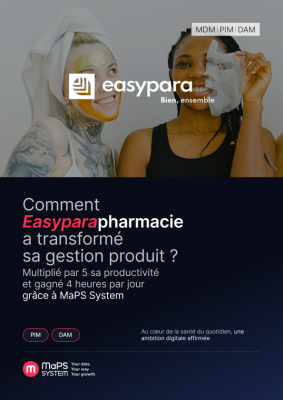
Easyparapharmacie – Structuring and ensuring the reliability of 45,000 references
- 26,000 structured references
- +50% efficiency
- More reliable data at all levels
Consult the Easypara case study
Oxycare – Boosting International eCommerce

- Presence in 7 countries
- 3x SEO traffic
- 4x revenue thanks to AI + PIM/DAM
Consult the Oxycare case study
Towards augmented data governance: PIM, DAM, MDM & AI
Ultimately, a product sheet is a mix of data, visuals, and documents, which must be up-to-date, consistent, and contextualised relative to the sales channel and market.
In this context, companies are choosing to use technological tools to drive data governance with more freedom.
This choice is mainly based on three technological pillars:
- MDM: structuring of reference data (products, suppliers, distribution network, regulations).
- PIM: enrichment and dissemination of product information.
- DAM: centralisation of digital content (visuals, videos, audio, diagrams, instructions, PDFs, packaging, etc.).

Today, aided by AI, this governance reaches a new level:
- Automatic information extraction from documents.
- Automated translation and enrichment adapted to markets.
- Intelligent classification of visuals and instructions.
- Targeted and consistent distribution.
Health and pharma data governance: the key to a lasting competitive advantage
In short, health and pharma data governance today is a real lever for strategic differentiation. Its benefits have a direct impact on your company’s performance:
- Reduction of data errors
- Acceleration of time-to-market
- Streamlining of internal and external exchanges
- Launching AI projects on a healthy foundation
So, before investing in artificial intelligence or international development, lay the solid foundation for your success with rigorous and controlled data governance.