
E-commerce product data sheet 2026: The complete guide to maximising your conversions
In 2025, French e-commerce exceeded €175.3 billion in revenue¹, an increase of 9.6% year-on-year. More than 73% of French people over the age of 15 regularly make online purchases², making the product sheet more strategic than ever. It is no longer a simple description: it has become your best salesperson, the one who works tirelessly to convince your potential customers.
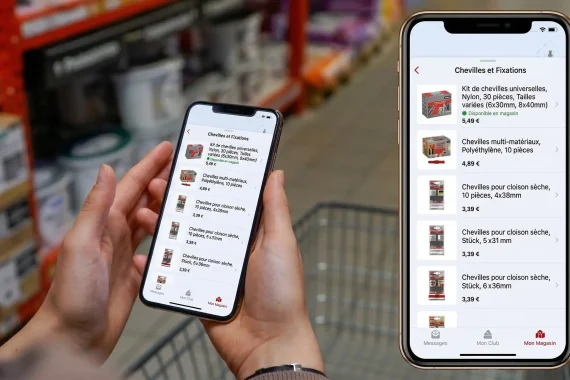
Experiencing a product always begins by finding out about its properties. The first contact is actually much more digitalised than we imagine. Between consumers accustomed to ROPO (research online, purchase offline) and the new phygital trends, a well-constructed product sheet is certainly your best asset for convincing them.
But creating high-performing product sheets in 2026 requires much more than a beautiful photo and a few lines of text. Between generative AI, the multiplication of sales channels, and the growing demand for transparency, discover our 10 essential tips.
Anticipate your customers’ expectations and master their new behaviours
Creating an impactful product sheet starts with truly understanding your customers. In 2026, their purchasing journeys have become non-linear: they discover a product on TikTok, ask ChatGPT for advice, compare prices on a smartphone in store, then perhaps finalise the purchase on a computer the next day.
Defining a typical customer profile remains fundamental. Is ecology important to your customers? This question is not trivial: 77% of consumers now consider themselves responsible³. Gen Z massively uses visual search: 22% of 16–34 year olds have already purchased via an image search². Furthermore, 68% of consumers trust AI recommendations.
The second-hand market is exploding: 51% of online shoppers bought at least one used product in 2024¹, representing a market of 128 billion euros. Understanding these new trends must inform your reflection on the structure and content of your product sheets.
The product sheet, your best online salesperson
Your product sheets must play the role of an in-store salesperson: provide clear information, answer questions, eliminate purchasing obstacles, and offer complementary products at the right time.
Write effective product titles and descriptions for all your channels
The title of your product sheet is much more important than it seems. It must be simple, explicit, and exactly match the vocabulary used by the internet user. There are still too many low-quality titles coming directly from the ERP without optimisation.
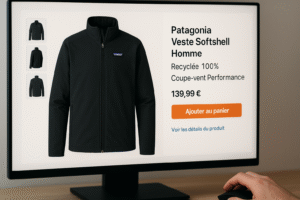
In 2026, your title must work on multiple platforms: Google, Amazon, TikTok Shop, and even in the responses of conversational AIs. The effective structure combines the brand, the product type, the main feature, and a differentiator: “Patagonia Men’s Softshell Jacket – 100% Recycled – Performance Windproof.”
The product description: tell an authentic story
Your product sheet must tell a story that consumers want to embrace. They must be able to project themselves into daily use. Clearly explain what the product does, describe the concrete benefits, and explain why you designed or chose it.
Aim for 300 to 400 words to improve your referencing, but always prioritise readability. Structure your content with ample spacing. Above all, do not be the umpteenth seller to use the same copy-pasted manufacturer description. Stand out and show why customers should buy from you. Google rewards original content.
Artificial intelligence for your descriptions
Generative AI can reduce drafting time by 80%, but use it with discernment. It should be your assistant, not your editor-in-chief. Always enrich the content with your expertise. Google penalises automatically generated content without added value.
Provide maximum detail on product characteristics
Product characteristics will capture your customers’ full attention. Transparency has become a determining factor: 55% of consumers say they are more conscious of their purchases thanks to the transparency offered by online product sheets².
Technical specifications remain essential: dimensions, weight, materials, performance. But in 2026, your customers expect much more. They want to know the labelling: organic, eco-responsible, made in France certifications. What standards do you comply with, such as vegan or cruelty-free certifications?
The environmental impact has become central. Indicate the carbon footprint if possible, the precise manufacturing location, the detailed composition, and recyclability. Usage and maintenance advice reassures about durability. Organise the information by themes: technical block, CSR and transparency block, practicality block, social proof block with ratings and reviews.
→ Discover our client case studies
Display clear and precise pricing information
All information relating to the transaction must absolutely be present. In a context where a third of online shoppers are looking to save money, price clarity is fundamental.
Your customers must know the price in their currency, the sales quantity, the delivery times and costs, and the available payment methods. Split payment (buy now pay later) has become an expected standard. Real-time availability is crucial: in-store stock, online only, or order lead time.
Return conditions must be transparent: free return, number of days to change your mind, refund procedures. Guarantees, their duration, and the possibility of extension are reassuring.
If you are running a promotion, display the duration, the strikethrough price, and the exact amount of savings. This complete pricing transparency reduces cart abandonment by 35%. These elements must be visible above the fold.
Create immersive visual experiences
Text plays an important role, but the perfect product sheet must include very high-quality visuals. The optimal number of images is between 6 and 8. 62% of the best-selling products on Amazon have at least 5 images⁴.
Don’t hesitate to add several types: 360° views, close-ups on details, in-use situations, photos from different angles. Always offer your visuals in the highest possible quality, 4K minimum. Provide the possibility to zoom in on details. Ideally, your visuals should occupy approximately 80% of the available space.
Video, the 2026 must-have for your product sheet
Do not neglect the influence of video. This format is highly demanded: text and photos have gradually given way to video, which is more personalised and engaging. Several types enrich your sheets: 15–30 second 360° product video, usage tutorials, unboxing, customer testimonials, lifestyle videos, integrated TikTok/Reels short formats.
Augmented reality
In 2026, augmented reality is no longer futuristic: 93% of Snapchat users are interested⁵. Use cases are multiplying: virtual try-on for glasses, clothing, or make-up, visualisation of furniture in one’s home, interactive 3D preview, real-time personalisation. This technology significantly reduces product returns.
Optimise your variations with impeccable ergonomics
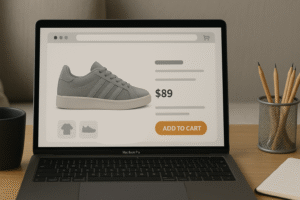
Presenting your product variations in a compact and ergonomic way on a single sheet helps to facilitate option comparison and significantly increases conversions.
To exploit full potential, customers must quickly understand the possibilities: colours, sizes, capacity. Dropdown menus allow for managing many options. Colour swatches offer an immediate visual representation. The easier the ergonomics are for testing variations, the easier the choices will be.
The choice of variations constitutes “micro-interactions” with your sheet. These create emotion and promote engagement. In 2026, AI can even suggest the correct size based on the profile: “90% of customers with your profile choose size M.” Some brands offer to upload a photo for the AI to suggest the colour that suits best.
→ Discover our client case studies
Capitalise on the power of customer reviews
What is more decisive than other consumers’ reviews? 95% consult reviews before buying⁶. 92% of French people consult online reviews before choosing a company. Reviews increase conversions by 270%. 86% of consumers hesitate to buy without any visible reviews⁷.
Don’t be afraid of negative reviews! 68% of consumers trust more when they consult both positive and negative reviews⁸. Exclusively positive reviews seem suspicious. Not providing the possibility to leave a review does not protect you: consumers will always find a way to express themselves.
Best practices for highlighting your reviews
Highlight your reviews visibly, preferably above the fold. Have your reviews certified by a specialised organisation such as Trustpilot or Avis Vérifiés. Display a detailed breakdown of ratings in the form of a graph. Highlight reviews with customer photos or videos: these rich reviews are the most consulted and convincing.
Active management is crucial: 69% of customers are more likely to buy from a retailer that responds to positive reviews, and 70% for those that respond to negative ones⁹. Therefore, respond to all reviews within a maximum of 24 hours. Personalise your responses. 59% of customers only trust the average rating if it has more than 20 reviews¹⁰. Furthermore, product sheets with reviews benefit from a 17% higher click-through rate on Google¹¹.
Short-format native video reviews (TikTok style) are starting to develop. Some brands also offer an AI summary of reviews that synthesises the strengths and areas for improvement mentioned by customers: “Customers love the quality but find the size a little large.” Detailed scoring by criteria (quality, value for money, delivery, customer service) allows for a more nuanced evaluation. Finally, community Q&A sections where customers answer other customers’ questions create engagement and reduce requests to customer service.
Integrate artificial intelligence to personalise the experience
In 2026, AI is no longer optional: 82% of e-commerce companies already use generative AI¹, well above the average for other sectors. AI can radically transform the experience on your product sheets.
Intelligent product chatbots can resolve up to 80% of queries without human intervention¹². 64% of customers appreciate their interactions for their speed. These assistants can converse in natural language, recognise images, offer personalised recommendations in real time, and intelligently compare products.
Dynamic recommendations based on AI analyse browsing history, previous carts, the behaviour of similar profiles, and the context (season, weather, trends). This personalisation increases the click-through rate by 35% compared to static recommendations¹³.
Real-time personalisation goes even further: the content automatically adapts to the visitor’s profile. A beginner user will see simplified explanations while an expert will access advanced technical specifications. Relevant promotions are highlighted according to history.
Focus on smart cross-selling
The perfect product sheet indicates accessories or complementary products at the right time. The figures speak for themselves: 35% of Amazon’s revenue is generated by its recommendation engine¹⁴. Furthermore, acquiring a new customer costs seven times more than retaining an existing customer.
In 2026, cross-selling becomes ultra-personalised thanks to AI. The “Frequently bought together” section offers smart bundles based on real behaviour, displays the total price with an attractive reduction, and allows one-click addition to the cart.
To succeed in your additional sales, certain criteria are essential. The addition must require no effort of reflection. The price of complementary items must not increase the cart value too significantly; limit accessories to around 30% of the main product. The added value must be unquestionable. The product must be attractive enough even if not strictly needed.
Use social proof: “87% of buyers of this product also took these accessories” considerably strengthens effectiveness. A 2026 trend is ethical upselling: offering a more durable version, suggesting eco-responsible alternatives, recommending a premium version with a longer lifespan.
→ Discover our client case studies
Adapt your product sheets to new sales channels
Your product sheets no longer only live on your site. They must be optimised to be discovered on multiple channels.
Optimisation for conversational AI
ChatGPT, Claude, Perplexity, and Google SGE are becoming major acquisition channels. 68% of consumers trust AI recommendations. To be visible, structure your data with Schema.org Product markup, write detailed FAQs that AI will cite, maximise your authentic reviews which are a source of trust, and create rich context content such as guides or comparisons.
The big change in 2026: AI platforms no longer systematically redirect to your site. They display information directly and offer in-app purchasing. Ensure your product data is impeccable to be cited favourably.
Social commerce: TikTok Shop and Instagram Shopping
More than 70% of consumers in Europe are attracted by live shopping¹. 39% admit to regularly giving in to impulse purchases on social networks¹. Adaptation requires an absolute mobile-first format, short native videos of 15–60 seconds, clickable product tags, and a maximum of 2 clicks to purchase.
Marketplaces: Amazon, Cdiscount, and others
Marketplaces generate 31% of online product sales revenue². Optimisation differs: marketplace SEO (Amazon A9 algorithm) attaches considerable importance to sales history and reviews. Images must comply with strict guidelines. Bullet points must be impactful, limited to five. An aggressive review strategy is essential. The price must be competitive to win the buy box.
Voice search and intelligent assistants
Alexa, Google Assistant, and Siri are changing the way consumers search for products. Voice queries are longer and formulated in natural language: “Alexa, find me a stainless steel Italian coffee maker under 50 euros” or “Ok Google, what is the best ergonomic office chair?”
To optimise your product sheets for voice search, write in question-and-answer format that corresponds to users’ natural queries. Use conversational language rather than fragmented keywords. Integrate local information such as in-store stock availability. Ensure your product sheets load quickly, as speed is crucial for the voice experience.
Live shopping: the immersive experience that converts
Live shopping combines the best of e-commerce and physical commerce. 67% of French people are attracted by this format which allows them to interact in real time with a presenter, ask questions, and immediately purchase the products presented. For your product sheets to be used effectively in live shopping, they must contain information that is easily communicable orally, dynamic visuals that work in video, and ultra-fast purchasing processes so as not to lose the impulsive buying momentum created during the live.
Recommerce and second hand
51% of online shoppers have already opted for second-hand purchases. The used market now represents 128 billion euros in Europe. In 2026, integrating recommerce options directly on your product sheets becomes a competitive advantage. Offer trade-in programs where customers can exchange their old product for a voucher. Display certified second-hand options for refurbished products. This approach addresses environmental concerns while making your products accessible to a wider audience.
The new regulatory and societal requirements of 2026
Beyond commercial optimisation, your product sheets must now meet growing legal and societal requirements. The European Accessibility Act becomes fully applicable in 2025, obliging e-commerce sites to guarantee the accessibility of their content to people with disabilities. This implies detailed alternative texts for all images, sufficient contrast between text and background, complete keyboard navigation without a mouse, and total compatibility with screen readers.
Transparency on environmental impact is also becoming a strong expectation, or even an obligation in certain sectors. Display your products’ carbon footprint when possible, clearly indicate the materials used and their recyclability, mention manufacturing conditions and compliance with social standards. This radical transparency, far from scaring customers away, on the contrary reinforces trust. 77% of consumers are ready to give up products from a brand whose production methods are harmful to the environment.
Towards simplicity: PIM as the central solution
After exploring these ten tips for creating high-performing product sheets, a question emerges: how to effectively manage all this information, maintain its consistency across all your channels, and guarantee its permanent updating?
The answer lies in three letters: PIM, for product information management. PIM is the conductor that centralises, enriches, validates, and distributes all your product information to all your sales channels in an automated and coherent manner.
The global PIM market is expected to reach $37 billion by 2030, with growth of more than 16% per year¹⁵. This explosion is explained by the growing challenges of omnichannel commerce. Without PIM, manually managing thousands of references across dozens of channels becomes impossible.
74% of companies use a PIM primarily to avoid data errors¹⁶. But the benefits go far beyond. A PIM significantly accelerates time-to-market, improves data quality, facilitates collaboration between teams, and ensures perfect consistency. Conversions increase: complete and rich product sheets can increase conversion rates by 20 to 40%¹⁷.
Modern PIM solutions now integrate AI functionalities that are revolutionising content creation. AI can automatically generate descriptions adapted to different channels, create content variations for different segments, and identify data quality issues.
Each channel has its own technical and editorial requirements. PIM manages all these specificities automatically. You enrich your content once in the PIM, then it adapts and distributes it according to the rules of each channel. This automation saves valuable time while guaranteeing consistent quality.
Investing in a PIM represents an initial cost, but the return on investment is quickly measurable. Companies generally see an 80% reduction in the time needed to create content thanks to automation and AI¹⁸. Time-to-market decreases by 50% on average. The error rate drops drastically, reducing product returns.
PIM also reduces operational costs: less time spent correcting errors, fewer resources mobilised for repetitive tasks. Teams can focus on higher-value-added tasks.
The important thing is to see PIM not as an IT expense but as a strategic investment in your ability to sell effectively across all current and future channels. In a world where contact points are multiplying and demands are constantly growing, PIM has become the essential foundation of any high-performing e-commerce strategy.
Product sheet excellence, a decisive competitive advantage
Product sheets are much more than simple descriptions: they are the beating heart of your e-commerce strategy. In a market where competition is intensifying, the excellence of your product sheets can make all the difference between a sale and a cart abandonment.
In 2026, creating high-performing product sheets requires mastering many dimensions: understanding your customers and their new behaviours, creating rich and authentic content, ensuring total transparency, offering immersive visual experiences, capitalising on customer reviews, intelligently leveraging AI, and adapting your content to multiple channels.
This increasing complexity makes product information management no longer optional but absolutely essential. PIM transforms product data management from an operational burden into a true competitive advantage, allowing you to orchestrate all these elements with coherence, efficiency, and agility.
Subscribe to our newsletter and discover our client case studies so you don’t miss our next articles on optimising your product data management!