Discover how AI is revolutionising the management of your master, product, and media data.


Enhanced QR Code: why the move to 2D is first and foremost a data project
The move to 2D changes what a barcode represents: from an identifier used at checkout, it becomes an entry point to structured product information that can be used by the supply chain, retailers’ IT systems and consumers.
For manufacturers, this is a fundamental shift: a scan no longer returns only a price, but a set of data whose reliability directly affects the checkout experience, traceability and downstream uses. In other words, as soon as you move to 2D, you are also dealing with data modelling, data quality, governance and distribution.
This transition aligns with the roadmap promoted by GS1 France: a migration from 1D codes (EAN-13) to 2D codes (GS1 Enhanced QR Code, GS1 DataMatrix, DataMatrix with GS1 Digital Link) and, crucially, a focus on a very practical challenge — real-world scanning and interpretation, particularly at point of sale.

“Enhanced” QR codes (GS1 or not): the real differentiator is data usability
A “classic” (non-standard) QR code most often links to a URL. It is easy to deploy, but the information behind the scan is frequently not very interoperable (each organisation defines its own formats, parameters and uses), which makes it harder for third-party IT systems — especially retailers’ — to consume.
By contrast, the GS1 Enhanced QR Code is built on a standardised approach using GS1 Digital Link: product identification (GTIN) is expressed in a URI and can be supplemented with additional data, making the code usable beyond a single use case.
GS1 France notes that the GS1 Enhanced QR Code “contains more product data”, encapsulated with the GTIN in a GS1 Digital Link URI.
Another structuring point is that the URI can be managed via a resolver (“smart traffic controller”) to route users and systems to the right content or service depending on context (B2B/B2C, traceability, checks, etc.).
The goal is not “putting a QR code on the label or packaging”, but operating a data asset: data model (static/dynamic), quality, governance, distribution and content — typically supported by an MDM / PIM / DAM foundation.
The move to 2D: a global transition, but success is won at point of sale
The “Sunrise 2027” initiative led by GS1 US sets a milestone: by the end of 2027, retailers should be equipped to accept 2D codes at checkout (alongside traditional codes).
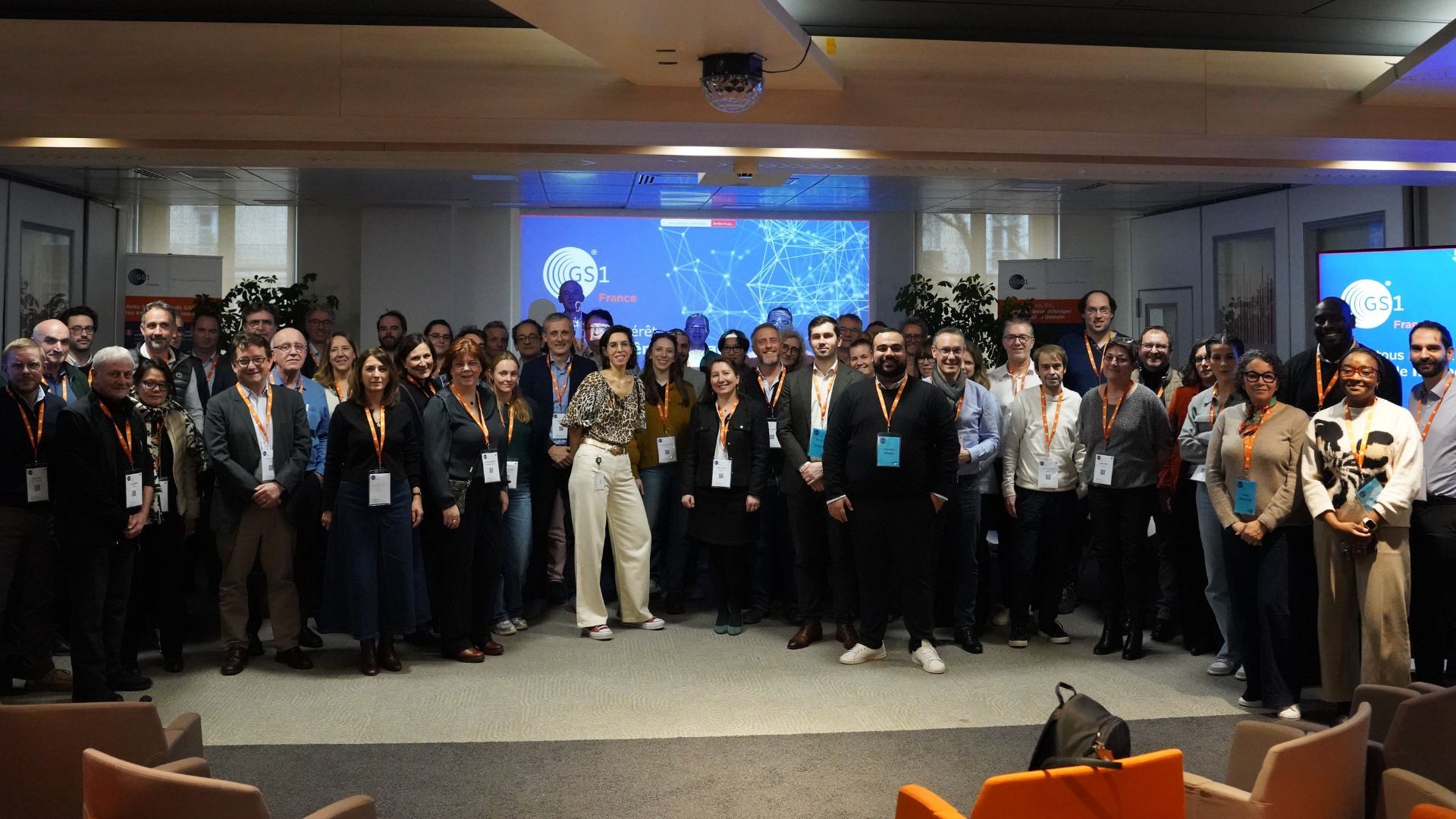
In France, GS1 France has moved from an informational phase to an operational one: the “2D Codes at Checkout Deployment Community” explicitly aims to run real-world tests on scanning and interpretation of 2D codes at checkout, with a test specification and scenarios to be formalised.
For manufacturers, the reality is simple: your codes will be scanned in heterogeneous environments (hardware, settings, retailers’ IT systems). The move to 2D therefore becomes an end-to-end project covering packaging, print quality, data and interoperability.
A closer look at 2D codes: QR, DataMatrix… and the key question of data
2D codes (QR, DataMatrix) have two structural advantages: greater capacity and more flexibility than 1D. But the industrial value really appears when you encode (or reference) information beyond a simple identifier.
Two families of data to distinguish
For systems to “understand” what is encoded, a shared language is needed. In the GS1 ecosystem, this role is played by Application Identifiers (AIs): numeric prefixes that define the meaning and format of the field that follows (e.g. GTIN, batch, date).
Digital Link: enabling the identifier for the web
The GS1 Digital Link can be encoded in a QR Code or a DataMatrix, and it provides access to a URL that can serve different needs (B2B/B2C) without tying the identifier to a single use.
Move to 2D: three success conditions in store
When people talk about the move to 2D, discussions quickly focus on “which code to choose”. In the field, the order of problems is often different:
- Scanning: does the scanner read correctly, quickly, without double scans?
- Parsing: does the system extract and structure the encoded data correctly (identifier + associated data)?
- Business interpretation: does the IT system apply the right rule (price lookup, date checks, blocking a recalled batch/lot, etc.)?
That is why the move to 2D is first and foremost a data project: if the code is readable but the data is incomplete, inconsistent or not interpretable, you do not create value — you create friction.
DPP: the 2D code is not the passport — it is the entry point
The Digital Product Passport (DPP) is a key element of the European ESPR (Ecodesign for Sustainable Products Regulation). 2D (QR/DataMatrix) often serves as an access or identification mechanism, but the passport itself is primarily a set of data (and evidence) that you must manage, version and maintain.
You do not “do” a DPP by adding a QR code. You do it by industrialising product data, traceability of sources, and the ability to distribute reliable information to different stakeholders.
MDM / PIM / DAM: the minimum data stack for an “industrial” 2D strategy
The move to 2D forces three very practical questions: Who is the product? Which information is true? Where and how should it be published?
This is exactly where an MDM/PIM/DAM architecture becomes structuring, as offered by MaPS System:
- MDM (Master Data Management): the backbone for identifiers and reference data (e.g. GTIN, units, hierarchies), with governance and quality rules.
- PIM (Product Information Management): structuring product attributes, managing variants and languages, and preparing for omnichannel distribution.
- DAM (Digital Asset Management): managing media and “evidence” documents (leaflets, certificates), essential when exposing content via a scan.
Industrial checklist: move fast without tackling the wrong workstream
- Define use cases (checkout, traceability, after-sales, compliance, DPP, experience) and decide what must be static vs dynamic.
- Stabilise identification (GTIN/keys) and governance.
- Define a “scan-ready” data model: fields, quality rules, dictionaries, units.
- Prepare IT operations: parsing, business rules, error logs, monitoring.
- Industrialise print quality and 1D/2D coexistence.
- Test in real-world conditions: scanning rate, throughput, errors, double scans, interpretation.
We answer to your question, F.A.Q :
MaPS System supports GS1 standards (including identifiers such as GTIN/EAN and GDSN).
Yes.
By centralising and governing product data (model, completeness, quality), MaPS System helps produce “scan-ready” data that the supply chain and retailers’ IT systems can use.
By improving data quality upstream (controls, rules, standardisation), MaPS System reduces parsing/interpretation risks on the retailer side during real-world tests.
MaPS System helps through the flexibility of its data model: it is designed to add new fields and requirements over time without breaking what already exists, while governing data and evidence (documents, compliance) needed for DPP.
Yes,
MaPS System centralises/structures product data, controls quality and generates compliant outputs (including GDSN). MaPS System publishes and synchronises within the GDSN network.