Discover how AI is revolutionising the management of your master, product, and media data.


Catalogue automation: boost your production with PIM & DAM
The catalogue, a marketing pillar that needs modernising
To sell effectively, a brand must be impeccable in the presentation of its products. In the age of digital and multichannel commerce, this involves managing massive volumes of product information and visual content: sometimes several hundred thousand references, each with its descriptions, prices, visuals, and variations.
However, catalogues—whether printed or digital—remain an essential tool for sales and marketing forces. Yet, their traditional, manual production is long, costly, and prone to errors.
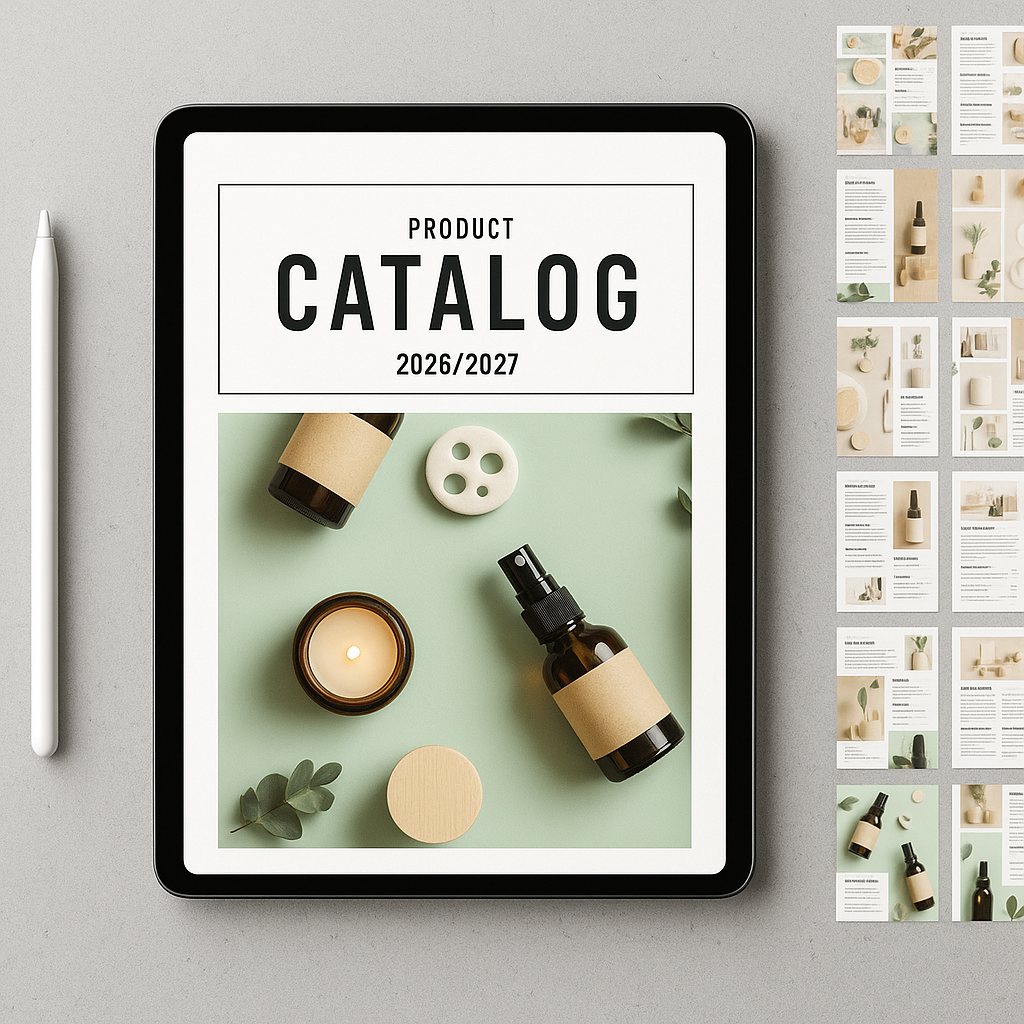
The combination of PIM (product information management) and DAM (digital asset management), associated with automated publishing, now allows this process to be radically transformed. This approach meets the growing demands of the market: rapid adaptation to product changes, multiplication of distribution channels, and personalisation according to targets.
PIM & DAM: the foundation for a reliable and up-to-date catalogue
PIM centralises and enriches all structured data related to the product: name, description, price, technical specifications, variations, stock levels, etc. It also ensures compliance with sector standards and legal obligations.
DAM manages visual and media content: high-definition images, videos, logos, technical, or marketing documents. It guarantees graphic coherence and facilitates collaboration between creative teams.
Together, they ensure that every product is presented with the correct data, the right visuals, and the right selling points, ready to be integrated into your communication materials. It is this association that allows for feeding a coherent, accurate, and multichannel catalogue.
PIM DAM facilitates the standardisation and centralisation of product data, thus simplifying distribution to marketplaces, print catalogues, interactive kiosks, and e-commerce sites. This centralisation becomes even more critical as brands rapidly expand across multiple sales channels.

Why automate your catalogue creation?
Traditionally, producing a catalogue mobilised entire teams for several months. Each update involved resuming data collection, manually adjusting layouts, verifying information, etc. A tedious process, often limited to an annual publication.
Today, market reality demands more responsiveness:
- New products added continuously,
- References modified or withdrawn,
- Multilingual or multichannel catalogues to update,
- Increased competition that pushes for multiplying publications.
The performance stakes are considerable. In a context where product cycles are accelerating and consumers demand increasingly precise and up-to-date information, automation becomes a decisive competitive advantage.
With automation:
No more heavy, one-off projects: you can publish several catalogues per year, depending on the market.
No more manual re-entry: information from the PIM and media from the DAM are injected directly into the templates.
No more endless delays: production time is reduced from several months to a few weeks, or even a few days.
Here is a concrete example: in distribution and DIY, a catalogue of more than 2,500 pages previously required 6 to 8 people for 9 months. Thanks to the MaPS System PIM + DAM and automated layout, production has been reduced to less than 2 months with only 2 people. The return on investment is immediate.
The impact of AI and new technologies
The integration of AI into PIM solutions is becoming increasingly common, with more and more providers offering AI-powered features on their platforms. This technological evolution transforms catalogue automation by making processes even smarter.
Artificial intelligence brings advanced functionalities such as the automatic generation of product descriptions, the automatic detection of errors in product sheets, or the suggestion of personalised content according to targets. This level of interactivity transforms static product catalogues into dynamic, attractive, and informative resources for customers.
Automated publishing solutions
Automation relies on the integration of PIM and DAM with layout and publishing tools, such as:
- Adobe InDesign for professional composition,
- Plugins like EasyCatalog, J2S, InData to directly connect data to templates,
- Or the MaPS Publishing module, natively integrated with the MaPS System PIM & DAM to generate catalogues on demand.
A proven and measurable ROI:
Companies that invest in automation see significant returns on investment. Beyond the concrete example mentioned previously, benefits are measured across several axes:
Reduction of operational costs: drastic reduction in production time, reduction in dedicated teams, limitation of costly errors.
Acceleration of time-to-market: ability to launch new catalogues in a few weeks rather than several months, responsiveness to market changes.
Quality improvement: guaranteed consistency across all media, automatic updating of information, reduction in the risk of manual errors.
Multiplication of opportunities: possibility of creating specialised catalogues by segment, season, or distribution channel without prohibitive overspending.
CTA: to find out the ROI you can achieve, contact our teams
Towards a sustainable transformation of the marketing function
Result: marketing teams focus on added value (creativity, storytelling, campaigns) rather than repetitive and time-consuming tasks. This transformation allows organisations to reinvest their human resources in strategic activities: performance analysis, customer experience optimisation, development of new creative concepts.
Catalogue automation thanks to PIM & DAM is no longer a simple technological advantage, but a strategic necessity to remain competitive in an ever-evolving commercial environment. Companies that adopt these solutions give themselves the means to